Most Recent News
Phase one background March 2014 October 2014
Friends hires restoration architect for a master plan.
By 2013, Friends of BNC had raised almost a third of our fund goal for restoring the artwork in the Ceremony Hall and the section restored during the first phase looks beautiful.
Friends was forced to suspend our restoration of the Ceremony Hall interior artwork when when a heavy spring storm revealed a water leakage problem in the domed roof. To continue with restoration inside would have been unwise, as the restoration could be ruined by water leaks.
We realized the work required licensed experts to assess the condition of the entire crematorium/columbarium building – interior and exterior.
March 2014
Friends of Bohemian National Cemetery has hired Charles Pipal, a well-respected preservation architect. Charlie surveyed the building on March 19th, 2014 and put together a proposal for development of a master plan for the building.
He returned on June 10th with project manager Dan Ruzic and Ed Scaggs from Knickerbocker Roofing and Paving Co., Inc., to conduct a thorough inspection. Knickerbocker submitted a report on the roof's present condition and what is needed to correct the roof problems.
Subsequent inspections prioritized recommendations for the repair and restoration of the crematorium/ columbarium building. This will lead to a series of projects, big and small, short-, medium- and long-term, for Friends.
October 2014
In September, the board of Friends of Bohemian National Cemetery voted to fund the top priority items identified in the report mentioned above. As a result, failing and missing tiles were replaced on the dome and loose cornice stones were reset. These actions should stop further damage to the dome this winter.
Much of the front terrace and steps of the columbarium/crematorium are in need of repair and replacement. This work cannot be done in the Winter and will await the coming of Spring.
For further details and pictures, see our Fall and Winter newsletters
click the link for the background of our restoration project
Interior restoration
(phase 1)
After Friends received a matching grant from the National Trust for Historic Preservation Cynthia Woods Mitchell Fund for Historic Interiors. Historic Surfaces LLC was chosen to conduct phase one of the restoration.
Historic Surfaces LLC finished the initial phase of the restoration project.

Anthony Kartsonas (on left), founder of Historic Surfaces LLC, and Andy Bultas, vice-president of Friends of Bohemian National Cemetery. photo by Chuck Michalek
Phase One steps included:
- Stabilization of loose paint
- Infill of losses in decoration to match the existing design
- Repainting of all flat and one color areas including all necessary surface preparation
- Restoration of scagliola columns, including removing the varnish and repolishing the surface
It was not uncommon for interior decoration to be a progression of changes and additions. This is certainly the case for the Ceremony Hall in the crematorium/columbarium building. After the original design was completed, later modifications were commonly done, often (but not always) by the original artist.
John Mallin received his first contract to decorate the Ceremony Hall in 1918. He received subsequent contracts from the cemetery association for additional painting of the hall in the decades to follow, with the last painting being done in the late 1940s.
Tony Kartsonas, our architectural conservator and historic finishes specialist
carrying out the restoration project, says that the Ceremony Hall is in
basically good condition except for areas of water damage. It is fortunate
that the Ceremony Hall had no previous, poorly done restoration attempts.

The scaffolding provides the workers thorough
access to the area being studied.
Photo by Tony Kartsonas
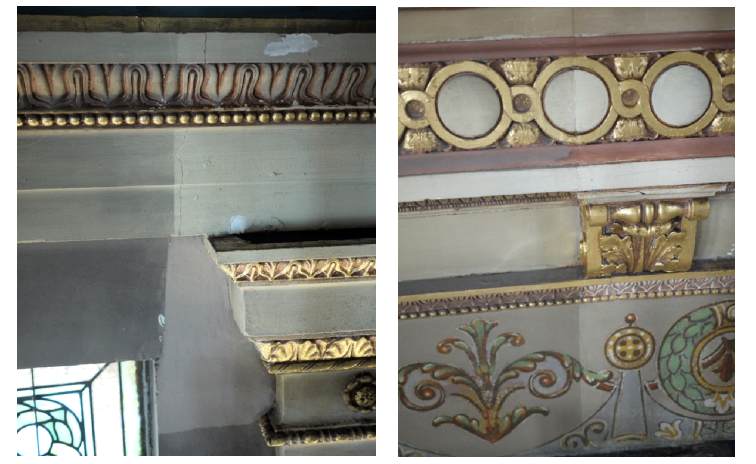
The gilt decoration on the plaster ornamentation appeared to be in pretty good condition. There is not much loss, and the gold leaf has not been abraded by previous cleanings.
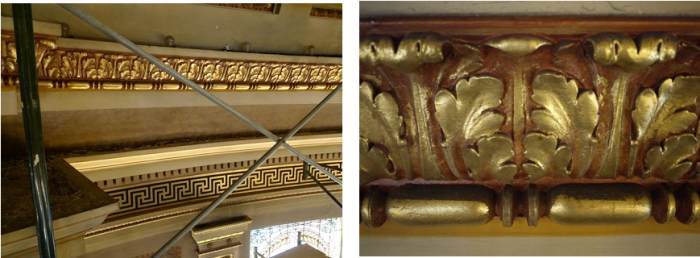
Photos by Tony Kartsonas
Close inspection showed significant areas of unstable plaster and paint.
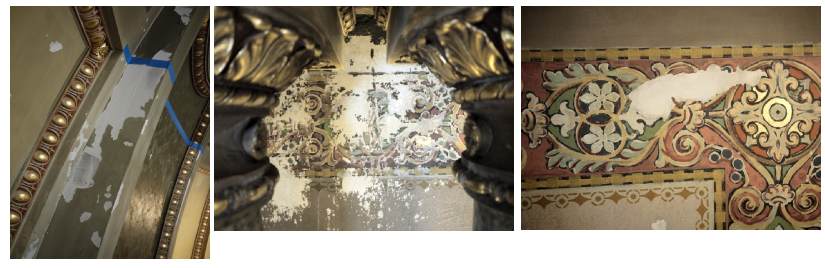
Photos by Tony Kartsonas
Some areas of paint and plaster flake off when touched. This condition is seen in both plain-painted areas (above left) and in some of the decorative elements (above center and right). Some sections are so deteriorated that they will need to be repainted completely. Other areas just need to be “inpainted” or “infilled.”
This art restoration technique of inpainting, also called retouching, re-establishes color and detail to losses in the paint layer, using a brush to apply a pigment mixed with an appropriate binding material. The flat and one-color areas cannot be infilled. Those surfaces have to be replastered and prepared as needed, and then completely repainted.
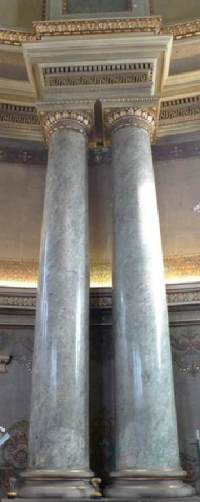 The
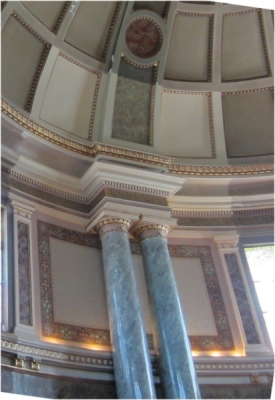
columns in the Ceremony Hall are excellent examples of marezzo scagliola,
a hand-crafted marbling technique widely used in the United States from the
mid-1800s to 1930s. This particular scagliola was made by splashing a paint
and glue mixture on oil cloth and wrapping the cloth around the columns
and smoothing the canvas. The paint was allowed to partly dry and, at just
the right time, the canvas was peeled away, leaving a surface that had to
be rubbed, sanded, and polished resulting in a lustrous marble look. At
some later date, varnish was applied to the columns. The marezzo scagliola
decoration of the columns probably dates to the 1920s.
The
columns in the Ceremony Hall are excellent examples of marezzo scagliola,
a hand-crafted marbling technique widely used in the United States from the
mid-1800s to 1930s. This particular scagliola was made by splashing a paint
and glue mixture on oil cloth and wrapping the cloth around the columns
and smoothing the canvas. The paint was allowed to partly dry and, at just
the right time, the canvas was peeled away, leaving a surface that had to
be rubbed, sanded, and polished resulting in a lustrous marble look. At
some later date, varnish was applied to the columns. The marezzo scagliola
decoration of the columns probably dates to the 1920s.
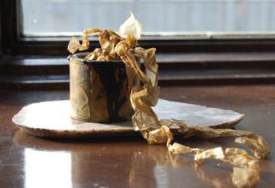
The gold leaf on the columns was put on over an earlier layer of aluminum leaf. Tony found a pot stuffed with aluminum leaf paper and other trash high up in the dome. Tony thinks it dates from the 1918 original decoration.

The cleaned areas stand out. 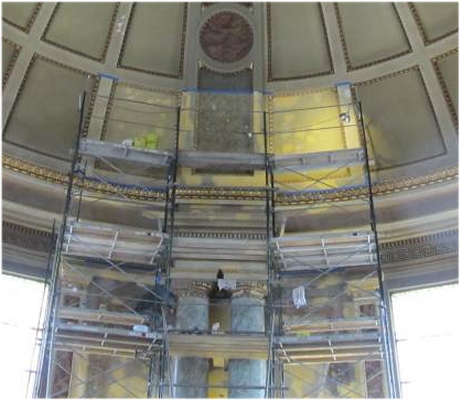

For further details and pictures, see our Summer 2014 newsletter